Monday, May 30, 2016

DJ Khaled: How Snapchat is Used to Spread the Major Key

If you have heard phrases like "major key", "another one," or "bless up" in the last year, you can blame DJ Khaled for that.

DJ Khaled to me is synonymous with Snapchat. While he does make music, he's become big and known for the keys to success that he shares with us lowly folk through means of Snapchat. These major keys have made him more famous than he was before, especially with youth.

DJ Khaled uses Snapchat for a number of things. For one, he uses it to spread positive messages to his viewers, telling them that life is amazing and something we should feel grateful for as a way of trying to inspire us. While it's kind of cheesy and often laughed at, I actually think it's a pretty great thing. The world we live in is filled with hate and gossip, and often times there's not a whole lot of people trying to build you up.
Secondly, he uses it to spread advice to his fans. Whether it's to have a lot of pillows or to use cocoa butter, Khaled tells us all the little things that can help us gain success. Dove soap, cocoa butter, watering your plants, all these things are keys to his success. “Almond milk. Cinnamon Toast Crunch. Major key to success,” DJ Khaled shows us all the things he does that make him successful.

Lastly, DJ Khaled keeps us woke. Lots of his snapchats tell us about "they". "They" represents those who want to keep us down, who make sure we don't have success, who make sure we don't get the things we truly want in life. "They" don't want us to eat breakfast. "They" don't want us to jetski. "They" is the force that stops us from doing the things we want in life. DJ Khaled is the one fighting against "they" as he has surpassed them. 
In short, DJ Khaled uses media to spread the messages he so wants us to absorb and show us how we can have the same luxuries that he does. 

What is Cool?: Merchants of Cool in 2016

Merchants of Cool had some very interesting ideas, which have become outdated. Since it was released in 2001, the people, songs, and ideas have long since became uncool. In 2016, there are new things that are cool in the eyes of teenagers, and new Mooks and Midriffs have made it out into the world. Let's find out what is considered cool in 2016.

Social media apps are the pinnacle of what is cool in 2016. Everyone has an Instagram, everyone has Twitter and Snapchat. This is the primary means of communication for a lot of us, and as such, advertisers have infiltrated the spaces we use to communicate as a means of trying to sell us their products. Promoted advertisements will appear on Instagram based on your interests or things you follow. Snapchat has a thing called Discover which has entertaining videos and articles put out by different companies. I wouldn't say it's explicit advertising, but it's something that gets the companies name out. It's a way to talk to millennials and gain an audience that is almost explicitly made up by youth.
These are a few of the companies who have taken to Snapchat to reach out to youth.

Now, I'll be honest, I have no clue who the Mook of 2016 is. If anyone has any idea who that might be, feel free to comment on it. I do think there are a few Midriffs this year.

Midriff was defined as a sexual cliche for female empowerment in Merchants of Cool. I think a Midriff might be Ariana Grande or Rihanna.  

I also think a Midriff might be Kim Kardashian. When she stood tall and confident when people were attacking her for the nude photo she put on twitter, she really embodied the idea of female empowerment because she wasn't ashamed of the body she has. A trait of the Midriff is that your body should be flaunted and I think she does that (not that that is a bad thing)

I'm not necessarily cool, so this post may be wildly inaccurate since I don't know a lot of what is. If there is any added insight, I'd love to hear it.

Sunday, May 22, 2016

The Actual Most Annoying Company of All Time (in my opinion)

(this is just one huge rant because apparently I've discovered my hatred for this ad again)

It's the reason I started paying for Spotify just so I wouldn't have to hear it anymore.

Lunchables Uploaded ruined my life.

There was a 30 second ad on Spotify over the course of last summer that made me more mad than anything else. I honestly started encouraged people to start boycott Lunchables. I was mad for reasons I couldn't quite explain.

Who's the subject of my rage? Malcolm McDowell, who plays an old man who knows nothing about youth culture that Lunchables hired for some reason. I'm not sure what they thought any of the ads with Malcolm McDowell would do to help their company, but it's whatever.


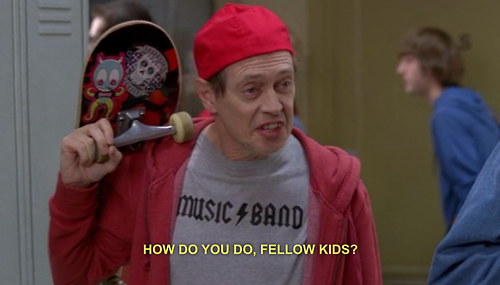
The ads with Malcolm McDowell attempt to target a youth audience, but I don't really see how these ads could ever be effective with youth. An old guy pretending to fit in with the youth is probably the worst way to target youth that I've ever seen. I'm reminded of that meme with Steve Buscemi in a hoodie carrying a skateboard saying, "How do you do, fellow kids?"
Essentially Lunchables way of advertising.

Look, Lunchables is just trying to find a way to fit in with the youth, despite the fact that their company is growing kind of irrelevant. These ads only prove that they are a company fresh out of ideas, and if they have to result to an old man to make any business (which probably hasn't worked) that's a sure sign that things aren't going so well.

I'm sure there's a smart mechanism hidden in this ad somewhere, but you have no  idea how annoyed I was at this advertisement constantly. Spotify made a good decision by playing this ad all summer, because I got so annoyed with Malcolm McDowell that I couldn't take it anymore and upgraded to Premium. Smart for Spotify, I suppose. Y'all have no idea how much I hate Lunchables as a result though.


Autism: According to the Media

Autism isn't a joke. It's something that exists withing a wide portion of people, who are all different and don't fit a certain mold. However, there are certain traits in the media that supposedly all autistic people possess, and that's what this post is about.

I'm no stranger to autism. It's something many people in my life have been diagnosed with, including my brother. I had a diagnosis at one point in my life, and although my diagnosis was taken away, it's still a part of who I am that I'm learning to not be ashamed of. I've seen and experienced first-hand the harmful stereotypes that are associated with autism. These harmful stereotypes can be executed through the media.

Autism Speaks is an organization that is very guilty of this. The things they put out about autistic people are some of the most offensive things that I've seen in my lifetime. The fact that they are the most well-known "charity" for autism only makes it scarier that their message is the one that most have seen. Here is a commercial Autism Speaks took down, but someone reuploaded. While they did take it down, it sparked much controversy and still reflects exactly how autism is portrayed by the masses.


The first half of the commercial is absolutely disgusting, and autistic people everywhere were enraged when this commercial was put out. Saying autism knows "no morality" portrays autistic people as cold, unrelenting, unforgiving. Saying "I will make sure that your marriage fails" tells every autistic viewer that by simply being themselves and existing, that they are responsible for any problems their parents face in their marriage. "I will make it virtually impossible for your family to easily attend a temple, birthday party, or public park without a struggle, without embarrassment, without pain." If Autism Speaks's intention was to make all autistic people feel guilty for things they aren't able to control, I guess they succeed there.

While it turns into a seemingly positive message halfway through the ad, according to this video, autism is something that needs to be eradicated, it's something that is bad. Something to look down upon, and it's something that we must fight. Autistic people are constantly erased through messages like these, and told that something that has become a part of who we are is something we need to get rid of. 

Other forms of autistic representations in the media portray autistic people as emotionless voids, such as Dr. Dixon from Grey's Anatomy who has Asperger's.

Dr. Dixon is very much portrayed as one-dimensional, and somehow has every trait at once, all to an extreme. She doesn't make eye contact with anyone, and doesn't seem to really have any emotions, among other things.

What the media fails to portray is the diversity among people who have autism. Autism knows no one form of existing. Every autistic person acts in different ways. While there may be some common traits, no one trait fits for everyone. No stereotype about autism, no negative connotation can be the case for everyone. 

Autistic people are wonderful. Autistic people are intelligent, autistic people have emotions, and we sure as hell aren't burdens.


Sunday, May 15, 2016

Being on the Set of a Commercial

A few weeks ago, I was granted the opportunity to be on the set of a commercial. This commercial was for Henry Perea, a candidate for the mayor of Fresno, California. The shoot took no longer than 2-3 hours and was a great glimpse into the behind the scenes techniques advertisers use to make their message sell better.

Watch the commercial here.

Henry Perea used to be a police officer, which they centered an advertisement around to show that he has done good work for the city of Fresno, and, if elected, he will continue to do good work for a city like Fresno.


Lots of little things go into creating a successful ad. For one, the lighting. The amount of light or the way the subject looks within the light actually matters a lot. In this commercial, they had Perea move into the light to give the impression that he is sort of the light in the dark, that he symbolizes change.

Second, the way the subject looks and talks. The way Perea talked was super important. He had to relay a serious but relatable and casual tone, which certainly isn't an easy task. He had to prove that he meant business, but was also a relatable and reliable candidate for the position. The way he looked during the commercial was also very important. For example, he had to make certain hand gestures at certain times. They also put a lot of emphasis on the smile you see at the end of the commercial. He had to smile to make him look more casual, which contrasts the seriousness of the commercial. The smile conveys a sense of humanity that is often absent from politicians.


The cutaways that they use in this commercial (a video of a driving police car) also help to make him message look better. The words  "to protect and serve..." on the side of the police car show that the line of work he comes from is beneficial to the community. Since he's also putting more cops on the street, it makes his agenda seem more beneficial to the community as well.

This commercial uses the Plain Folks technique because it talks about an "old-school, conservative" approach. The target audience is an older community because they want to target the largest voter turnout, and the emphasis on taking it back to the good old days works best with an older audience.

Every little thing that they put in a commercial serves a purpose. Being able to see the other side was an excellent opportunity to learn about advertising.

Gendered Toys: Why?

I don't mean to get completely social-justice like, but in a world that encourages diversity, it's really weird that children's interests are determined by their gender. Your gender determines the type of life you live in and determines all of the things that you will enjoy and entertain yourself with.

I've always been intrigued by the fact that you can quickly tell what toys are meant for what gender. Isles meant for girls are dominated by pink and purple, by fairies and dollies, by dresses and bows. Isles for boys contrast this drastically, dominated by blue and grey, by trucks and soldiers. When children are limited in such a way, when children are told that they can only play with certain things because it's  "for boys" or "for girls," it perpetuates the stereotypes of what a boy is or what a girl is.

Advertisers are less worried about the effects that this could have on children's mind, and have more concern over how much money these toys will make them. Of course it's okay to enjoy princesses if you're a girl or trucks if you're a boy, but when society tells you your interests must be limited to things related to your gender, that's when it becomes not okay.

The drastic differences between isles designated for boys and designated for girls tells children that their interests must be defined by their gender. 

Advertisers use gendered toys as a means of trying to make a bigger profit from certain demographic. Telling little girls and little boys that these toys are the only ones they can play with limits their options and makes them likely to buy from that small selection. Advertisers do this so they can make more money off of the stereotypes that they've set. This, however, has more harmful effects than they could ever imagine. 
These toys set the base for what is considered feminine behavior and what is considered masculine behavior. Little girls who would rather be playing with Power Rangers are shamed for not showing interest in Barbies (I was that little girl.) Boys who enjoy dolls are laughed at for being 'girly' in a society that perpetuates the idea that being a girl or being girly (that is, exhibiting behavior like a girl would) is perhaps the worst thing you can be. It also separates genders and discourages boys and girls from ever finding common ground. The fact that the toys directed at boys work on spatial reasoning skills and relate to taking action or building things, and toys for girls work on creativity and are often times related to cooking, dressing up, or makeup tells children what they must be interested in. These stereotypes can make their way into adulthood and can have massive effects on what jobs kids think they are able to do.

Lately, companies have been taking strides to break down these stereotypes by making toys more gender-neutral, and I applaud this movement. It's good for us to encourage children to play with what they please, and to develop interests that are more than is what expected of them. We should be doing all we can to try and abolish gender stereotypes, even if advertisers aren't totally pleased about it.  

Sunday, May 8, 2016

Stop Stigma Sacramento: Advertisements with a Progressive Purpose


All of us in Sacramento have certainly seen these billboards. A person who is smiling at the camera, maybe a parent, maybe a pastor. An everyday person who just happens to live with a mental illness.


Stop Stigma Sacramento has done incredible work in challenging preconceived misconceptions about what mental illness is. Mental illness doesn't challenge one specific type of person. It affects people spanning across different skin colors, genders, different sexualities, and economic statuses, 1 in 4 people will experience a mental illness within their lifetime. With the right support system, people can seek and find treatment.

This is where the problem is rooted. People who suffer from mental illnesses are perceived in a negative light. Mental illness is something to look down upon in the eyes of a lot of people. People who face mental disorders will often be called 'lazy', "overreacting", or just plain "weak." None of these can take into account the intense pain of mental disorders. These harmful stereotypes inhibit over half of those living with mental illness from seeking treatment. These terms make it so people never want to/try to receive help from a professional, because of the fear we as a society have instilled on people who experience mental illness. These advertisements are helping to make a difference.

Stop Stigma Sacramento puts these billboards in your face as a way of reminding you that the people near you, the successful scholar in your class, or the always seemingly happy kid around school may be suffering from a mental illness. People with mental illnesses can never or never will fit into one mold. People with mental disorders may often act happy, they may be productive, they may be geniuses. These things and mental illness are not mutually exclusive and can coexist within the same individual. Stop Stigma Sacramento uses advertising as a means of breaking down the harmful stereotypes of what someone living with a mental illness must be, in hopes that more people will feel comfortable seeking help. It helps to remove the shame that shouldn't have ever existed so that more people will be able to seek treatment.

It's a reminder that a person is more than the illness they have. This, to me, is so important.

No one with mental illnesses should ever have to feel that they are less of a person because of it. Mental illness should never have to be equated with shame. As someone who lives with mental illness, I have experienced first-hand the harmful stigma and stereotypes equated with it. I have been told countless times that I am just "part of a trend", that I am "lazy and disgusting", and that the obstacles I face in life are things I have "made up and need to get over." Something like Stop Stigma Sacramento helps to remind me that there are people around me that do not fit those harmful labels, and maybe I don't either. It helps to remind myself that I have absolutely nothing to be ashamed of, and anyone who thinks I should feel ashamed is only affected by the stigmatization of mental illness. That, just like mental illness, is something that can be treated if we all put in the work to stop and refute those stereotypes whenever possible.
For anyone reading this with a mental illness, and for anyone who has been told that they're not good enough because of it, you are amazing just the way you are.
Stop Stigma Sacramento is more than just an advertisement. It's a way of creating change in the community, a way of creating change for 1 of 4 people diagnosed with a mental disorder. I couldn't be more proud to live in the city that's challenging stigma so openly.

Memes in Advertising


Anybody who's been within 3 feet of me should know that I love memes. Memes are the language of the Internet, and, although silly, can bring a community of individuals together. Unsurprisingly, the advertising world has found a way to use memes to their advantage. Maybe I'm a little biased, but the humor that comes from memes tempts me to want to buy their products.

Let's take a look at Denny's. Denny's is a restaurant popular with the old. It would make sense for them to try and target youth through something as versatile and tied to the Internet as memes. Denny's has become popular for their wacky sense of humor, but it's tied to an advertising mechanism.


Denny's tweeted a version of the quickly growing "here come dat boi" meme as a way of appealing to youth with bad senses of humor similar to myself. What this does is targets youth to remind them about Denny's, a place you don't often see teenagers. While this may not seem like an advertisement because there's no specific product being promoted, this is advertising because it's getting Denny's name out there to a demographic who wouldn't normally indulge in the restaurant.

Another franchise fond of memes is Sonic the Hedgehog. Sonic has had some very bad games and memes have been made as a result. Sonic's media people decided to play on that to redeem themselves from the hole they drove themselves into.


This is a double advertisement for Sonic and for Pizza Rolls, and is meant to target a demographic who would think this is funny.

Memes are used by companies as a way of advertising specifically to youth. And if you're as much of a meme loving loser as I am, it kind of works.

Sunday, May 1, 2016

Dove's Successful Methods of Advertising

Dove has always been a very positive and inclusive, which is something I really enjoy seeing. Dove has gone out its way to challenge status quo notions of beauty, which often center around skinny white women. Campaigns for Dove have included women of all sizes and of all skin colors in an attempt to challenge what we know as beautiful. It has done its very best to dissolve the stereotypes that prevent women from seeing themselves as beautiful. Beauty exists in each of us and it exists in many different shapes and forms. However, one look at magazines and mass media will tell you that the only form of beauty is in that of a skinny white woman. The images on magazine covers are always photoshopped, always edited so their skin is perfect and their bodies are flawless. These harmful images tell young girls out there that because they don't look like the girls on magazines, they will never be able to call themselves beautiful. Dove sees that this is wrong, and started using advertising as a way to oppose the common standards of beauty.
Dove's Campaign for Real Beauty centers itself around helping women discover their beauty and increasing self-esteem in women everywhere.

While I would argue this is the right thing to do regardless of your intent and I really enjoy what Dove is doing for young girls, Dove also does this for advertising purposes. Dove uses body positivity to help promote their products. Dove commercials center around promoting women, a more recent advertising technique which centers around being positive and reaching to demographics that have been left out of the media for a long time. Since women are more often than not subjected to harmful stereotypes at the hands of men everywhere, Dove uses these ads to remind women that they're beautiful just the way they are, which makes them more likely to buy their products. 

Now, please don't get me wrong. I really do enjoy the work that Dove is doing and believe that any chance to bring up women in a world that constantly tries to tear them down should be done. However, we must consider the ways in which Dove uses this to advertise their products. Take, for example, their latest ad. 


This ad shows many different hairstyles which Dove tells you to embrace. Express yourself in a way that you want to. This positive approach is a good way of getting women to want to buy their products, because it is coming from an industry that doesn't want to judge the way you look.

In short, the work that Dove is doing is great for women and challenging notions of beauty that harm them, but also great in helping Dove make more money.

Product Placement - Food Network


During an episode of Guy's Grocery Games (don't judge me) one chef on the show was waiting for his turn to check out. Since he had time to kill in the checkout line, he picked up a conveniently placed magazine and said, "While I'm waiting, why don't I read the best magazine in the world, the Food Network magazine?" The cover of the magazine was made very clear to see by Chef Morrow. This show obviously is trying to promote the Food Network to its users watching it on Netflix. The magazine was specifically placed right in front of the camera so we would be able to see exactly what the magazine looked like. Since this was being watched on Netflix, which doesn't have ads, they put the advertisement into the show as a way to sneak in advertising. It was used to let users who may not watch the Food Network know about it as a way to promote it. This show took advantage of the fact that he was not doing anything, so they used that to their advantage by plugging their products.